The concept of power resides in beliefs and faiths. The different beliefs and faiths are what give the many perspectives to any situation that reduces the factual content to insignificance most often. More than an alliance to it at a philosophical level, the strong hold of the system is the need for a familiarity. Dogma sets in for whom this system yields an invaluable social currency and most often it is the ones who wield the power. Yet for a vast majority for whom the status quo is not comforting, they are ready, almost eager to shift their belief system – if that’s what it would take to get them an advantage point in the power dynamics. These shifting belief systems are what makes history so fascinating and elusive in spite of its factual dates that chronicle the progress of events.
Yet there is one type of a shift in one’s own belief system or perhaps a very conscious enquiry of it. Something that is more innate – arising within an individual and not necessarily as a device to gain power. From Buddha to Ashoka to Gandhi, we see the individual at conflict as a response to the social and political system that governs their time. Their personal struggle seeps into the social fabric as well and alters the larger eco system. What final shift may have happened in them as an individual is one aspect; but the cultural and civilizational significance of this personal enquiry are the pivots of the human race’s progress. Isn’t it?
Personally, for me, I am captivated by these individuals who engage in this deep deliberation with their own set of belief systems and faiths. Deep diving into them via books and documentaries has fed my curious mind but never satiated it. As a non-academician or say with a person who has a nonlinear thought process, very soon the sequence of events get muddled but some deep essence drawn out stays – but I struggle at times to trace back on how that essence was drawn. At these times, I have wondered what it would have been like to have lived along with them and mark out their evolution for myself. However, it never struck me to seek out for someone in the current times who I could observe and chronicle who might be critically engaging with their own belief system. And somewhere there at a time of my own personal chaos and confusion where I was tangled in my own beliefs and suspended by my own faith; I stumbled upon T. M. Krishna.
Discovering Krishna
Over the last couple of years, I am consciously habituating myself to refer to people and personalities by only their first names. However, I do fumble and many a time continue to call many people still with their suffix and prefix basis the popular public discourse and my own previous references to them by those salutations or their sir names. But Krishna for me is Krishna, in-fact I find it odd when I do refer to him as T.M.Krishna.
The main reason for this is that I have had no public discourse baggage with regards to him. I was oblivious, so surprisingly oblivious about the very existence of him. I would listen to some Carnatic music, go to a lot of live performances, read extensively the many authored editorials and participate regularly on twitter banters and discuss people and personalities with family and friends, who all have very strong views about Krishna. And yet, not once in the many years did I ever come across him and that is most astonishing. When I did come across him some 5odd years back, it was in an article by Ramchandra Guha, where he was referring to Krishna as a case in point for facing the brute force of the growing intolerance for having a plural outlook. It could have been one of the many articles of Ram that I could have read, ingested the narrative and completely forgotten about the specifics; but for one word he used to describe Krishna, which was ‘institution’. If any other person would have referred to Krishna as an institution also, I may not have given a second thought to it, but it was Ramchandra Guha and at that time I was finally progressing towards the completion of the sequel of his Gandhi’s biography.
This news article was forwarded to me by my husband, Sidhanta. After reading it and re-reading a few lines over again, I ask him, who is this guy! My husband, usually kind and patient with me while educating me on many things, was most animate. He showed me pictures of Krishna from the net to see if I do recognize him. No, absolutely not. I was seeing those images for the first time. Sidhanta was truly flabbergasted and I was so confused myself to look at him react in such an uncharacteristic way. Anyway, he then shared a YT clip of Krishna’s Magsaysay award speech and Alice stumbled into the rabbit hole!
For the many weeks that followed I had devoured the net of all interviews and articles of Krishna. Over dinner, would double click on some of these with Sidhanta and he helped me unpack the many nuances in his old style with no judgments.
Of course, the appeal was that I aligned to the sensibilities of the topics and views that Krishna engaged in. I have been engaging with those subjects myself via many other sources, that’s why the surprise that I never stumbled upon him before. Yet when I heard him talk or read what he wrote about those very ideas and issues that also consume me, I found a completely new vantage point of engaging with those topics. What he got to the discourse was not a full formed opinion, but his own personal vulnerabilities. He got questions and what he seeks is not answers to them, but an inquiry on why is he feeling so unsettled with those questions. He is questioning not the world outside of him, but the one within him that contains him. He is shifting his own inner axis and calibrating it most meticulously, by re-interpreting his own beliefs and motives and adding new dimensions which complicates a simplistic narrative, but broadens the scope of the conversation.
Thus, discovering Krishna was not just about stumbling into something profoundly beautiful. It is about keeping up with Krishna, to observe the mutation of a human will and see the alchemy of kindness unfold.
My litmus test
Gautama Buddha is most enchanting in his doctrines that he preached and prescribed. Beyond the theology, the impact it had in the economic growth and urbanization of civilizations beyond India was also truly remarkable. I will avoid the temptation to dwell on its present condition and go straight to the point that I want to make – which is about a Hindi poem by the thought-provoking poet ‘Maithili Sharan Gupt’ called as ‘Sakhi Ve Mujhse Keh Kar Jaate’.
The poem is about how Buddha’s wife Yashoda must have reacted on finding out he has gone in the cover of the night to seek the unknown, without any prior indication to her and intellectually betraying her. The poem is like a permanently pierced thorn in my feet, that hurts every time I take a step towards discovering not just about Buddha, but any man who has gone onto change the world. Over the years, the context has expanded for me beyond the role of the individual’s partner and family to a broader view on how individualistically or collaboratively does this individual want to engage in positively impacting the social system.
In this interrogation of mine of Krishna, in this first step of me wanting to discover him, for the first time, the thorn did not pierce. In the materials that I found about Krishna revealing his inner shifts; his family, close network of friends and specifically Sangeetha – his wife, are a part of his ongoing mutation. But it is more brilliant for me to see Sangeetha stand so autonomously in her own skin. There is absolutely no sense of ‘w/o’ attributed anywhere in her identity. Beyond what is on the net – said, spoken and written about, I of course have no sense of their personal dynamics. But as one of Krishna’s collaborators and colleague in the musical world, there are glimpses that we get on the dynamics that they share. And it must be because I am pet peeved on such finer aspects of individuals, that even before I discovered the musical genius of Krishan, the first concert that I attended of his was ‘Karnatik Kattaikkuttu’ where he fused the worlds of classical and folk art and one of his key collaborators was Sangeetha.
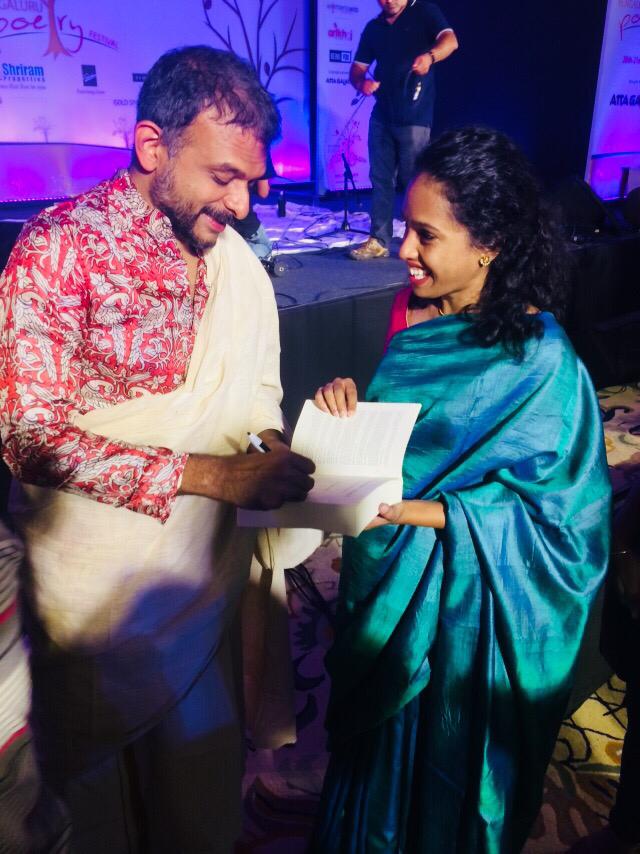
Post-concert, my first concert that I hung around instead of hurriedly leaving, I saw the audience hive around Krishna. I did not know one could take selfies with artists of this stature and repute, and there Krishna was indulging a rather greedy crowd. And I kept searching for Sangeetha and saw her interacting with fans of her own and be so unfettered on the buzz around her husband. I also reluctantly braved up and got a selfie with Krishna, completely unaware of how it would turn into a concert ritual. But my mind kept going back to Sangeetha and her clear sense of groundedness amidst the frenzied life of Krishna.
5 years later, on the exact same date of this concert, I attended the ‘Friends in Concert’ where again Sangeetha was a part of the great ensemble. For all the gol-gol talk that Krishna did about the idea of this concert, she spoke most crisply and decisively making an immaculate point on friendships that exist in the professional space.
Well to be clear, I am not championing the idea of ‘behind every successful man there is a woman’. It would be more apt to say – how many successful women are thriving in the ecosystem of a successful man. But that is also not the whole point I’m trying to make. The point really is about the equity that people who are bearing witness to the individual’s life have in their intellectual and social pursuit as well as their own agency of wanting to align or not align to their outlook. To be able to maintain an identity that is independent of the individual is a true litmus test of what kind of social change that individual wants to bring about at a macro level.
This is really the single largest reason why I am obsessively invested in Krishna. It’s not the genuineness of his intent and action to do good that makes him an important figure to recon. It’s all the people that are in close proximity in his life who also exhibit a very independent thought of a larger good and how he is in fact learning from them to better himself and also champion their passions as vehemently as they do his. Be it his mom, wife, daughters, students, friends, colleagues, public intellects, artists from more fragmented forms of art or even his fans – if you are wanting to observe, you can observe the osmotic nature and influence they have on Krishna and Krishna has on them.
Art as a witness
When we talk about cultural heritage, the art of a civilization is a critical part. In that, the artforms that is patronized by the ruling class goes onto occupy high echelons and preserving and progressing it also becomes a part of the power structure of its times. These artforms are housed in the bodies of the artists and are passed onto a new generation by systematically exercising the muscles of prodigious talents. The collective memory of the audiences also plays a crucial part in what progresses and what languishes into oblivion. Today what we refer to as Indian Classical Music, has traversed multiple generations, social contexts and power structures to remain appealing to today’s time. And T.M.Krishna exemplifies the geniusness of one such artform called as Carnatic Music. Much debate arises on his engagement with this celebrated form. He did not settle reaching the pinnacle, but seems like he only got started from there, where he questions himself and as a virtue of so much of his identity rooted in this music form also questioning the notions associated with Carnatic Music.
Krishna’s singing prowess is that of a very high artistic excellence. A sonic texture that is stirring even to an untrained ear that is not familiar with any of those compositions. Yet, his voice moves you. Moves you not with poignance. Neither with joy. But moves you and you become aware.
I remember vividly the first time I heard and then watched him sing Mayamalavagowla. I had tears streaming down my face. I can’t explain why. In the pursuit to catch up on such vast digital content so easily available in today’s time freely, his songs were a kind of a white noise playing in the background. This one time, while I was manoeuvring through a few excel sheets to make sense of some business trends, this song was playing in one of my many open tabs. Halfway through the song, the music which was in the background of my attention and focus, very gently made way into my foreground, without displacing anything. I can’t explain what it made me feel. I won’t even say I was crying. I was just overwhelmed. It felt like I discovered something in me which I had not previously known.
Thus began my conscious engagement in his music as well. I was lucky that my first few concerts of his, were not just pure Carnatic Kutcheris. But they were the ones where he sang only poems of Perumal Murugan or only songs of the many marginalised communities and all of them within the Carnatic music framework. I developed this great appreciation to this artform that is so distinct in its artistic identity, yet so inclusive and expansive. While many new custodians of the artform are changing the traditional structures of the sonic textures by adding techno beats and gathering packed houses for stand in concerts where the crowds are singing along while waving their mobile torches or even to listen to ‘Srirangapura Vihara’ or ‘Manavyalakinchara’ play in cafes; Krishna is doing something far more challenging to keep the artform relevant. He is creating art for that someone in a far future. He is excavating history. He is preserving history. Most importantly, he is recording history.
Manodharma
5 years back to this day, when I first discovered Krishna, it was also the beginning of many political events at an accelerated scale that were set with a motive to undo some core constitutional values. While the many principles of the constitution were still in theory and being fought on how they can find their true expression in reality – be it on women empowerment, gender identity, agricultural policies, environmental policies, status for SC/ST communities; the abrogation of Article 370, CAA and the Ayodhya verdict leading to the construction of a temple. Amidst all this was the Covid scare and the sense of uncertainty was never this high for our generation. All of these major events got the questions of nationalism which was in the background of our identity to the foreground in a very disturbing way.
In the larger chaos that was unfolding, having found Krishna at the same time was a gift given by providence to me. He engaged in each and every of these issues along with many that he was already actively involved. His engagement was not in the mere ‘intellectual’ way of just a commentator. But being an active participant and mobilizing some initiatives while shouldering so many others.
He was uncomfortable. And he got this discomfort of his to the concert stage. He was brash to also tell that anyone who was not interested in his unsettled state, may leave. He was called arrogant. He challenged the audience – his audience, his discerning audience. What does an artist want more than the halls full and thundering applause? How cuckoo of him to gamble that? Many left with a sense of betrayal. But my goodness, the many who came in, the many who are coming in, the many many more who are yet to come in.
A work of art primarily is an expression of emotion. However with some natural skill and a disciplined training the aesthetics of that art can be very well mimicked and proliferated. The later element is very important for the art to journey and find new spaces and become part of new context and commerce setting. It’s okay I think to call the vast majority of people who are essentially a form of a media vehicle of an artform also an artist, however a more apt term would be an art practitioner. But who cares for nuance?
I think that for someone to become an artist at any random time of their life without any inherent talent is easier. Since the birth of art is like a life in a seed which we all carry with us and for a few when that seed meets a fertile ground, it comes to life to create an expression that has an identity of its own. The honesty in that expression is what gives it longevity and allows it to transcend time.
But for an art practitioner, who is demonstrating their art in a controlled environment and playing to their strengths, and gathering those accolades; to find that unadulterated seed within them I assume is a rarity. But when you do stumble upon that seed, what do you do with it? You have the soil. You have the tools. But you don’t know what the produce will be and if you would have any takers for that produce. And yet to nurture that seed is some sort of bravery, I think.
Thus, what Krishna is doing purely as an artist on the concert stage and forcing his audience to engage and not just consume his art is something that needs an academic reading. From the poems of Perumal Murugan to Narayan Guru to setting tune to Ashoka’s edicts to the vast theological texts, he is a curator of thoughts. From singing Rabindro Sangeet to unsung verses of the anthem as well as Abide with me and Hum Dekhenge, he identifies himself as a fellow compatriot and not a performer. When he sings Jamuna Kinare, Damadam Mast Kalandar, Allah Megh De or Paga Gunghru there is something so familiar to the many unfamiliar audience and yet it is so new. But my most favorite moments are when he sings of those ancient compositions and is himself moved and there is a silence of a few seconds, which feel extremely long. In that silence he creates a space. A space for you to also engage with yourself. Infact, it was one of those deliberative moment he had while singing Mayamalawagowla and I thought there was a glitch on my Youtube tab, since I could hear faint sounds of instruments but he suddenly goes quiet. It was his silence that caught my attention to his singing and I checked on the tab and in an instant the tears he was fighting back started flowing in my eyes.
I am plugging in here, something that I had posted on IG once about Krishna and Manodharma, as I find it apt to describe not just his musical genius but also his engagement with the art and its audience as well:
“Manodharma in certain Indian musical repertoires is a concept where a musician improvises in the flow of a performance, creating indescribable moments of richness that is assimilated over recurring engagement with that particular musical piece. Or perhaps something more.
It comes to one in a moment of consciousness. Thus, these moments cannot be recreated.
This is what transforms certain artists into legends. These legends add from the depths of their being, which is rooted in their receptiveness. These moments are the fruits of their deep meditation which while being exquisite in taste and nourishment also house seeds for future exploration.
And Krishna, not a singular fruiting tree but an abundant forest in himself, is evocative, in not just in his music; but even in his writings, lectures, interviews and random shenanigans. His artistry is in his ability to hold onto your attention with such rapt command that the world around you, as you know it dissolves. He dissolves in it too. In that moment of disintegration everything reintegrates and you see the world anew.”
No Man is an Island
There is so much I perceive about human behavior via Krishna that he is almost like a subject matter himself. There are broadly two things where I gain an immense perspective through him – firstly that kindness is a highly evolved state of being and you need not wisdom alone to be kind. In-fact, really high intelligence and a hunger for knowledge is a prerequisite to be kind. We talk about kindness in a very soft skill and docile way and not as an enabler to build economic prosperity for a larger minority groups through inclusiveness and equity.
Second thing I observe and try to learn from Krishna is on the concept of optimism and that it is not a philosophical state of being magically hopeful but a key motivator where you are an active part of creating a better world. Your hope for positivity steams from the fact that you have faith in your action – what you are putting as an input, which can be measured and accounted for creating positive impact.
For both these, the energy that he has is astounding.
It is truly remarkable how amidst a packed concert schedule which he starts dot on time but abundantly overshoots, being not just a spectacular individual to be interviewed where you get a little bit more nuance to his grey cells, but also being a greater interviewer himself where you know he has come prepared to steer the conversation in new directions, as a champion cheer leader to so many of his friends, attending his students and new generation artists concerts during the music season with such passionate enthusiasm, continuing to teach music and probably beyond music to a whole new generation, participating in congregations of descent and engaging with political leaders about whom he has critical views, collaborating with diverse artists to explore and expand the musical repertoire, create platforms where lesser known artforms can be preserved, progressed and made part of main stream, actively write in scheduled columns, doing those runs, climbing those mountain summits and what not.
Its not extraordinary that he does so many things in a rhythmic continuation. Its extraordinary that he does so many things at scale and impact. Take for instance ‘Sebastian and Sons’ – a seminal book on the history of the Mridangam makers. It is an anthropological in nature and is addressed so holistically with taking into deep consideration on so many pure scientific workings of the instrument to the socio-economic construct around these instrument makers. Or look at the Ashoka Edicts project as well. Engaging with academicians, scholars and linguists to bring into our popular conscience on what those edicts have to say by laying them within a musical composition. Both these projects can truly become part of a curriculum in the social sciences. And it wasn’t that while he was doing any of these projects, he was only doing that. A few years back while researching for something, I came across this wonderful TED talk by Tim Harford on a topic called ‘slow motion multi-tasking’. In finding that, I had a definition to also define the curious mind of Krishna too.
Krishna is a person with not just a restless mind but a restless heart too. He for me truly brings to life every word in the brilliant poem ‘No man is an Island’, especially the below stanza:
“Any man’s death diminishes me, Because I am involved in mankind.
And therefore never send to know for whom the bell tolls; It tolls for thee.”
Thus, you see an optimist turn a cynic too.
His tolerance for a false sense of bonhomie and celebration is absolutely absent. While the social media timeline is replete with Diwali celebrations, he puts up a picture of himself wearing a ‘keffiyeh’ and speaks his thoughts on how can we miss the irony where we are celebrating the night sky light with sparks while in some other place the same thing means the announcing of death. Or when the whole nation was erecting the tri-color in their apartment balconies and again the social media was filled with a cookie cutter content throughout celebrating with pride on being an Indian; one Indian who’s voice preserves most evocatively one of the most celebrated art forms of the many India’s gone by asks ‘What shall I sing about?’
A man with errs
The beauty of an image is not that of which is visible due to the light that is projected on an object – but the shadows also in its focus that allows for what is seen, to be seen in depth. That’s what makes Krishna so charmingly attractive – isn’t it?
Between his inherited identity and the many other identities he is consciously acquiring, there is a steep path he is traversing. For instance, as a vocal champion for feminism and a continued voice on #metoo you are only grateful for the amount of authenticity he brings in to each of these movements. Yet at times, in some random post and responses on Twitter and IG stories, you see an undertone of sexist remarks which are intended to be read with satire and in context to some other post, nevertheless sound sexist. These are times when I feel such great disappointment and it reminds me that, unless you have not experienced the threat, you can never truly understand it, however empathetic or how ever high your EQ may be. But I am also so glad that this one time, when he was trying to condemn a twitter banter started by some insignificant person in the similar tone of voice, Chinmayi Sripaada a noted singer called him out for his insensitiveness in his response. If someone else may have called out, I don’t think it would have mattered as much as her and he responding to also with an apology shows that the progressive nature is a WIP but more importantly genuine.
Apart from matters on feminism, I don’t take offence to his contradictions. I do however maintain a meticulous tab on the number of times he would have re-defined a nomenclature and how sometimes he goes back to the old definitions by virtue of it being an old habit. And I do enjoy the criticisms around him and at times it also puts a small question in my mind. For instance, while an article that praised his digital streaming of ‘Friends in Concert’ during the lockdown, it also criticized it on the high streaming fee and how for a champion who talks about making arts accessible this was against the grain. While for me this was not really a contradiction, as fair economics does not mean free economics, Krishna did respond to that criticism. He immediately made the concert free for anyone who shared their student id cards and I for some reason felt personally proud of him.
In another instance when he posted about a new litter of pups on the street, his daughter came down sternly upon him instructing him to take them all inside the house and a few of his students absolutely seconding her on that. But also, the many many animal lovers who are so invested in the street animals, also not falling for the cuteness of that video but having a very educative conversation on the need to spay street dogs.
Many instances like this on a diverse range of topics is what makes the engagement real with Krishna. It’s not a transactional engagement between an artist and an audience which only allows for ego massages and creating loud echo chambers, but a very responsive and a deliberative one.
Circling back to my one constant theme that we should not place so much emphasis on just an individual, who is a part of a sum, but take into account the whole summation; the beauty of Krishna however is that, he may not be the single highest value on the left-hand side of the equation. But he most definitely is the fastest compounding value which makes him significant.
But there are many matters on which I don’t have any understanding to truly have an independent opinion, like the Sangita Kalanidhi Award that is bestowed on Krishna this year.
I have a small network of acquaintances where we have connected over Krishna and then diverged on other conversations, as well as converged from many other conversations within my personal network who are usually much older in age and are huge Carnatic enthusiasts to exchange notes on Krishna. As they educate me on the overall artform itself, they also reminiscence on the transformation of Krishna the artist and a majority of them, while appreciating his vocal political views would have a sense of remorse on how he has sacrificed and forfeited the Sangita Kalanidhi Award. Such a common poignance in all of their tones when they would say, ‘who but him is more deserving of that title’. And I have no idea on what they are saying but understood that it must be something big, to see such a common emotion towards that award and what it must mean in the Carnatic world.
Much like his cover story on M.S. Subhalakshmi published in Caravan, I could see logic when he argues that how she was projected in a certain way to appease to the Carnatic world’s nomenclatures and questioning perhaps on how much artistic freedom she may have had. I don’t get the sentiment and the emotion of his or his critics rubbishing that article at all. Similarly, I was missing why his fans had this pain for him missing out on the title. In my head it was so simple – Gandhi never got a Nobel Prize for Peace, but who else could have mobilised civil disobedience and passive aggression as a way to get freedom when the world was high on gun powder and had just discovered the ability of atomic bomb?
The news first comes to me as a message from another fan girl and she messages hoping that he will accept it and not refuse it. My first thought is, wow, Music Academy is quite generous and mature indeed. And then comes a message of acceptance from Krishna, something that so many of his fans must have been anticipating with a bated breath. The next speculation now is will he actually sing this December in the music festival?
Here is where I am so happy being a dispassionate observer.
He gets the award, he does not get the award, he sings in the music festival, does not sing in the festival – it means nothing to me for the lack of sentiment and knowledge I have over its relevance. But it is surely important to note and study the whole episode for the sake of objectivism. Both the institute and Krishna in my opinion at some point in time, having gained some retrospective view should surely share the rational and emotional aspect of one bestowing the award and for the other to accept the award addressing all the controversial points.
Of course, they are absolutely not obligated to engage in that conversation. But in a time of AI and Generative AI, where the mass assumption in the Carnatic consciousness was contrary to the academy’s and Krishna’s action, we need to zoom into the finer aspects to find what makes the human mind and behaviour truly un-hackable. Also, most of the criticism for me was just such high drama of a prevalent lack of sportsmanship, but for some views I caught by some of the artists coming from the marginalised communities, whom Krishna champions. There is much sensitivity there, again something which is completely not in my awareness but I reckon that needs a deeper investigation and to be addressed and engaged with much respect.
But there is a view that Krishna holds which I want to agree to, but find it difficult to truly accept fully. His views on capital punishment. While the logic and reasoning with which he champions against it makes absolute sense, when you view the case like Nirbhaya and the perpetrators of that gruesome act, mercy cannot be justice for me. Is hanging them justice delivered one may ask – and my answer is that I don’t know. But things get complicated when I think about the hanging of Afzal Guru. And as I continue to sometimes cue ‘aye malik tere bande hum’ these contradictions of capital punishment give me a throbbing headache. Usually, I am fine not having a view on something at all; but in this case being disoriented irks me. It is accentuated further because a person who I consider a fountainhead has such clear views on it and something that I can not fully accept yet. As I continue to engage in these ideas, Krishna along with his foundation ‘Sumanasa’ launches a pilot program called as ‘Art in Prisons’ which is developed for the inmates. Wooooowwww….it really blows my mind on how Krishna has an assertive action in every sphere that he talks about and infusing music and meaning into it.
O there are so many more things about him that one can debate and argue, agree and disagree with. But while most of us are limited to our faculty of theoretical arguments our man has moved onto his next thought experiment through an assertive action. Surely his every action will be questioned and judged, no not the ones from the mindless trolls, but by his discerning community who places some faith of humanity in him. Somewhere I think it is only fair for him to justify to them so that he can become a better version of himself and as he also rightfully acknowledges in his acceptance post of the Sangita Kalanidhi Title, when he writes “…I have erred and fallen many times, and I will in the future. But I do hope that those close to me remain who they are and music continues to show me the way.”
But I think a more poetic caution is given by Shakespeare when he writes:
“They that have power to hurt and will do none,
That do not do the thing they most do show,
Who, moving others, are themselves as stone,
Unmoved, cold, and to temptation slow:
They rightly do inherit heaven’s graces
And husband nature’s riches from expense;
They are the lords and owners of their faces,
Others but stewards of their excellence.
The summer’s flower is to the summer sweet
Though to itself it only live and die,
But if that flower with base infection meet,
The basest weed outbraves his dignity:
For sweetest things turn sourest by their deeds;
Lilies that fester smell far worse than weeds.”
Post Script – On writing this Blog
After much contemplation on a very busy working week, I took a day off to go to Chennai to see the ‘Friends in Concert’ an ensemble of 13 artists on Jan 19, 2024. But I was awestruck that it serendipitously coincided on the same day 5 years back when I saw Krishna’s first live performance and it gave me a conscious measure of how long I have been invested in this one individual. Thus, I did not want to just mark that event as another IG post and wanted to reminiscence my memory of the last 5 years and how Krishna has been a light house in the current political turmoil that is changing the fabric of our sense of culture rapidly.
Well, after some 6000 odd words nothing much on that concert is mentioned here at all. Neither are my views on Krishna’s wardrobe styles, his live streaming shenanigans, him occupying the stage with artists who have different political views than his, the unplugged concert that I arranged in Bangalore and that beautiful experience, his student community of artists who are so inspiring in their own independent dialogues, his many art initiatives, to my thoughts on his small stretch of the walk in the ‘Bharath Jodo Yatra’, to my wonderful and growing collection of selfies with him, to so many other things.
I’m not resigning from the pursuit, but I am resting from it and taking an indefinite break. Not completing this blog has been a bit irking in the back of my mind and I had to put the 3 odd months restlessness to ease.
But this exercise of recording my memory has been personally joyous for me. You may find some thoughts galloping from one vein to another, and that is because of prolonged days and sometimes weeks between writing. But I have kept the incoherency here to preserve the integrity of the thought that I would use as a medium to summon my views on Krishna. So, in a sense, this could be like a quilt that is stitched by many scraps of individually beautiful pieces of thoughts and memories to create a comforting caress in future times of distress.
Krishna is a cultural phenomenon. And it is my absolute privilege that I have such a close view of his thought experiments. He inspires and motivates me everyday, a part of which I think I have been able to construct in some frame work here but there is still some part of his aura that I cannot articulate. My apologies if I have misinterpreted anything he has said or done, but more than just mere factuality the way to read this is on the way we synthesise information from our idols to draw strength in times of distress.
More power to Krishna and the many minds like him!
 Aishwarya Omprakash
A – you are in the wrong profession. I think you should write more.
B- when I started reading I noticed the meandering thoughts and was wondering why you were jumping from 1 to another, but your postscript kind of gave clarity on that. Like the analogy of the quilt.
c. In your journey of Krishna , I do hope and wish you find answers to the questions in that brilliant mind of yours.
Yet again do write a book sometime. And think of me when you get a Booker !! 🤗🤗
LikeLike